
Laser welding and TIG welding can both join stainless steel, but they handle heat differently. That difference can affect how much the surrounding metal distorts, how the weld looks, and how much cleanup the part needs afterward.
For thin stainless steel parts, laser welding can be a good option because it produces clean welds with minimal distortion. TIG welding remains useful for joints where its level of control and the specific requirements of the part make it a better fit.
The right process depends on the part you’re making, the joint design, and what you need the finished product to look like.
How Laser Welding and TIG Welding Differ
Both processes use heat to join metal, but they deliver that heat differently.
Laser welding concentrates heat in a small area. This can help limit the effect on the surrounding metal, making it useful for thin stainless steel parts where distortion and surface appearance are concerns.
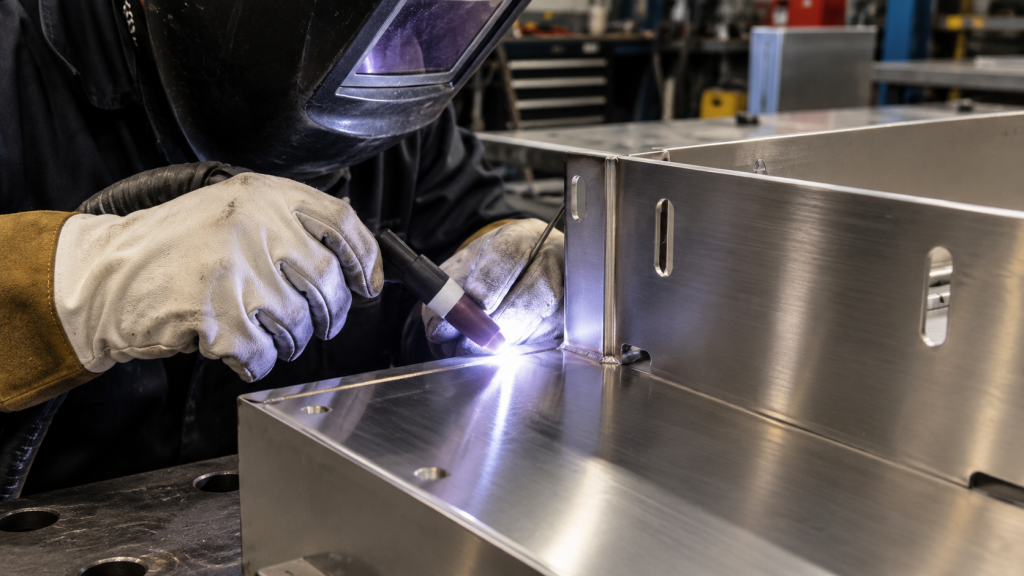
TIG welding uses an electric arc to create the weld. The welder can carefully control the heat and weld pool, which makes TIG useful for a range of joints where precise placement and a controlled weld are important.
Neither process is automatically the better choice for every stainless steel part. The joint design, material thickness, and finished requirements all play a role.
When Laser Welding Makes Sense
Laser welding is particularly useful when keeping heat input and distortion low is important.
Stainless steel sheet can be sensitive to heat during welding. Too much heat can cause warping or affect the surrounding surface, creating additional work to bring the part back to the required shape and appearance.
Laser welding’s concentrated heat input can help reduce these effects. It can be a good fit for thin stainless steel components, visible seams, and parts where a clean weld and minimal distortion are priorities.
Less distortion can also make it easier to maintain the shape and fit of fabricated parts. Depending on the joint and the required finish, laser welding may reduce the amount of cleanup needed after welding.
At Elliott Metal Works, laser welding is one of the available welding processes. We focus on clean, low-distortion welds, particularly for stainless steel and thin sheet metal.
When TIG Welding May Be the Better Choice
TIG welding is still a useful process for stainless steel fabrication. It offers precise control over the weld pool and can suit joints where the welder needs to manage the weld carefully.
The best choice depends on the joint itself. Joint access, fit-up, material thickness, and the required weld all influence which process makes sense. TIG may be more suitable for some joint configurations, while laser welding may offer advantages for others.
It’s worth evaluating the actual part rather than assuming one process will always produce a better result. A process that works well for one component may not be the right choice for another, even when both are made from stainless steel.
Elliott Metal Works offers TIG welding as well as laser welding, allowing the process to be considered in relation to the job’s requirements.
What Should You Consider When Choosing?
If you’re planning a stainless steel part, a few details can help determine which welding process is appropriate.
- Material thickness: Thin sheet metal can be more susceptible to distortion from welding heat.
- Joint design: The shape and accessibility of the joint can influence which process is suitable.
- Finished appearance: Visible welds may need to meet particular appearance requirements.
- Distortion and fit: If the part needs to retain its shape or fit with other components, controlling heat and distortion can be important.
- Post-weld finishing: Consider whether the part will need additional cleanup or finishing after welding.
These factors work together. No single item determines the right process in every situation.
If you already have a drawing, it helps to include the material, thickness, joint details, and any requirements for the finished weld when requesting a quote.
Choosing a Welding Process for Your Part
Laser welding and TIG welding each have a place in stainless steel fabrication. Laser welding can be advantageous when low heat input, minimal distortion, and a clean result are priorities. TIG welding remains a valuable option for joints that benefit from its control and flexibility.
At Elliott Metal Works, we offer both processes and can review your part’s requirements to help determine a suitable approach.
If you’re planning a stainless steel component, send us your drawing or sketch along with the material, thickness, quantity, and finishing requirements. We’ll review the project and let you know how we can help.