
If you’re planning a laser-cut sheet metal part, one of the first things you’ll want to know is how thick the material can be.
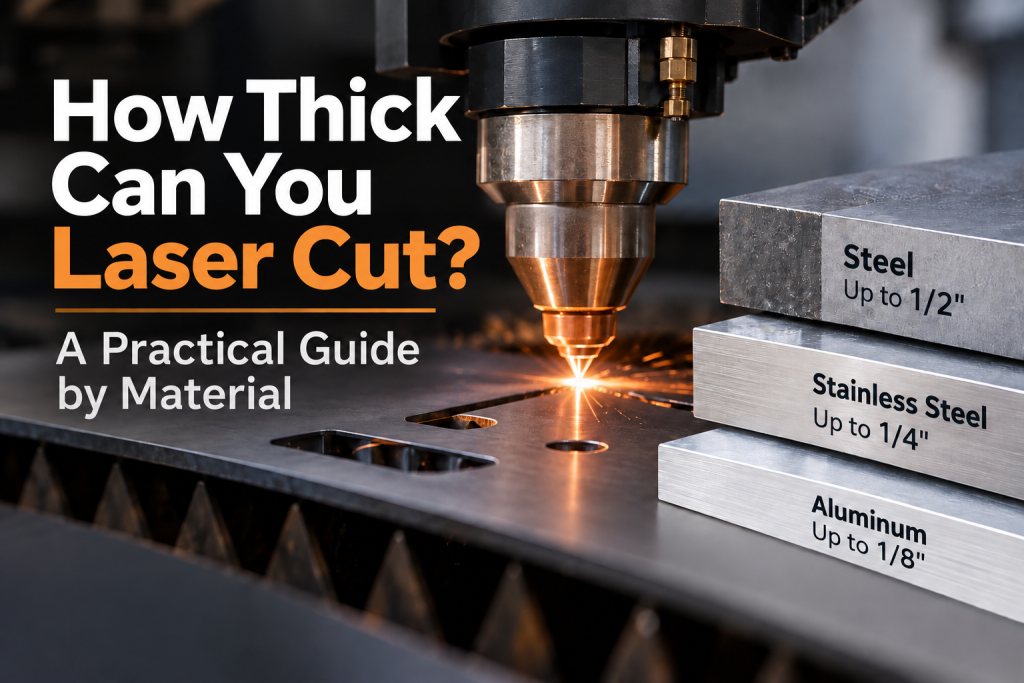
The answer depends on the material. At Elliott Metal Works, our published laser-cutting limits are up to 1/2″ for steel, 1/4″ for stainless steel, and 1/8″ for aluminum.
Those limits give you a good starting point, but choosing the right thickness isn’t simply a matter of picking the thickest material we can cut. The material and thickness should make sense for what the finished part needs to do.
Steel: Up to 1/2″
Steel is a practical choice for many fabricated parts when strength and durability are important.
Elliott Metal Works can laser cut steel up to 1/2″ thick. That gives you a broad range of options for brackets, panels, enclosures, and other fabricated components.
The thickness you need still depends on the application. A part that needs to handle a significant load may call for something different from a cover or bracket where keeping weight down is more important.
Using thicker steel may add strength, but it also adds weight. The best choice depends on what the finished part needs to do.
Stainless Steel: Up to 1/4″
Stainless steel is often chosen for its corrosion resistance and appearance.
Our laser-cutting capability for stainless steel extends up to 1/4″ thick. It’s a practical choice for parts exposed to moisture or environments where corrosion resistance is important, as well as parts where the finished appearance matters.
The type of stainless steel and the desired finish can also be important considerations when you’re planning a finished part.
Aluminum: Up to 1/8″
Aluminum is useful when keeping weight down is important.
Elliott Metal Works can laser cut aluminum up to 1/8″ thick. It’s a common choice when a part needs to be lighter than a comparable steel component.
As with the other materials, the appropriate thickness depends on the part and what you expect it to do. Material selection and thickness should be considered together rather than separately.
Maximum Thickness Isn’t Always the Right Thickness
It’s easy to look at a material’s maximum cutting thickness and assume that’s the thickness you should use. But the maximum we can cut and the thickness your part actually needs are two different questions.
Consider how the part will be used, how it will be assembled, whether weight matters, and what kind of environment it will be used in. Those factors can help determine the material and thickness that make sense for the project.
That’s why it’s worth considering material and thickness during the design stage rather than simply choosing the maximum available.
What If Your Material Is Thicker?
If your project calls for something thicker than those limits, laser cutting may not be the right process for that particular part. Heavier plate work can call for different fabrication methods and equipment.
If you’re working with a thickness outside our published limits, send us the drawing or sketch along with the material you’re considering. We can take a look at the project and let you know whether it fits our capabilities.
Don’t Forget the Rest of the Fabrication Process
Laser cutting may be only one step in making the finished part.
It’s also worth considering how the material will work with the rest of the fabrication process, including bending, welding, or finishing.
A thickness that works for the cut itself may also need to make sense for the rest of the fabrication process.
When you request a quote, providing the drawing, material specification, thickness, quantity, and any finishing requirements gives us a better understanding of what you’re trying to make.
Start With the Part, Not Just the Material
There isn’t one thickness that is right for every application.
Start with what you’re making and what the finished part needs to do. From there, the material, thickness, and fabrication requirements can be considered together.
If you already have a drawing, PDF, or sketch, send it to Elliott Metal Works. We’ll review the project and let you know if the material and thickness fit what we can do.